
Hearing Loss and Tinnitus — Ankara
Treating hearing loss depends first on establishing its type. Losses arising in the outer and middle ear are often reversible; where the inner ear is involved, how early you present changes the outcome considerably.
Sudden hearing loss is an emergency
Hearing loss in one ear developing over hours or a few days is treated as sudden hearing loss and considered an emergency. The earlier treatment begins, the better the chance of recovering hearing.
In that situation, seek ENT assessment as soon as possible rather than waiting. A blocked feeling in one ear that does not clear should not be dismissed.
Types of hearing loss
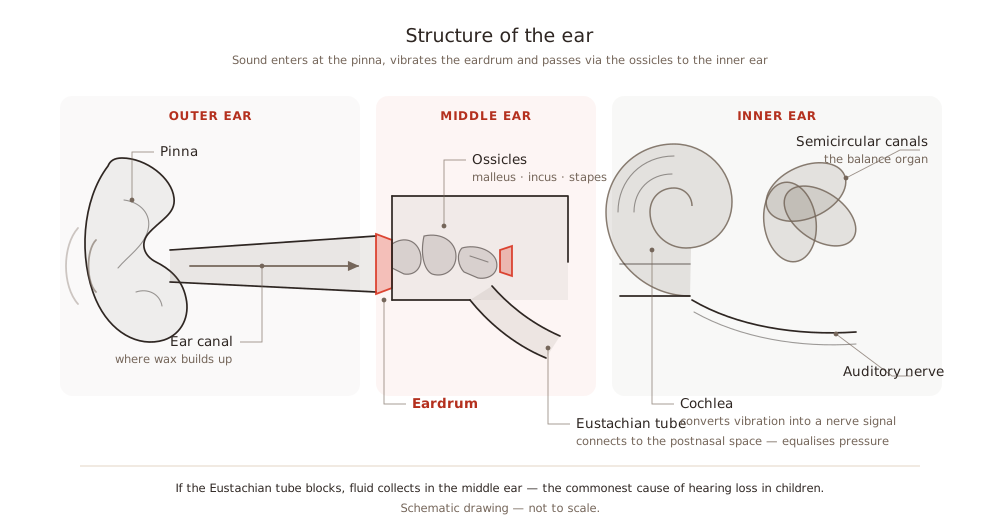
In conductive loss the problem is sound reaching the inner ear: wax impaction, a perforated eardrum, fluid in the middle ear or problems with the ossicles. Treatment is usually possible in this group and hearing returns.
In sensorineural loss the problem lies in the inner ear or the auditory nerve. Age-related loss, noise-induced loss and sudden hearing loss belong here. Treatment is sometimes possible; in other cases a hearing aid is considered.
Mixed losses, with features of both, also occur. The distinction is made with a hearing test, and the treatment plan follows from it.
Tinnitus
Tinnitus is a symptom rather than a disease. Most often it accompanies hearing loss; wax impaction, noise exposure, certain medications, jaw joint problems and changes in blood pressure can also produce it.
Assessment aims to find whether there is a treatable cause behind the sound. One-sided pulsatile tinnitus, and tinnitus of sudden onset, need separate investigation.
Where no cause is found, the aim shifts from removing the sound to reducing the distress it causes. Sound enrichment, better sleep and reducing triggers such as caffeine are part of that approach.
How it is assessed
- Ear examination, with microscopic cleaning where needed
- Audiometry, showing how much loss there is at each frequency
- Tympanometry, measuring middle ear pressure and eardrum movement
- Imaging and advanced audiological tests where indicated
Recovery
- First visit Examination, ear cleaning and hearing test. In sudden loss, treatment begins the same day.
- First 2 weeks The period in which response to treatment for sudden hearing loss is most evident. Tests are repeated.
- Months 1 to 3 How much hearing has returned is assessed. Hearing aid options are discussed if needed.
- Follow-up In noise-induced and age-related loss, hearing is monitored at regular intervals.
These are average times; recovery varies from person to person.
Written and medically reviewed by
Ear, Nose and Throat Surgeon · Last reviewed:
Frequently asked questions
Is using cotton buds a problem?
Yes. Cotton buds push most of the wax deeper and make impaction more likely, and there is a risk of injuring the eardrum. The ear cleans itself; where cleaning is needed it should be done by a doctor.
Will my tinnitus go away?
If a treatable cause is found, it can. Where no cause is found, most patients gradually attend to the sound less and the distress lessens. Sleep and stress markedly affect this process.
Will a hearing aid make my hearing worse?
No. A properly fitted device does not damage hearing. Early use is in fact recommended so that the brain's representation of unheard sounds does not weaken.
I work in noise. What should I do?
Use appropriate hearing protection and have your hearing monitored regularly. Noise-induced loss cannot be reversed once established, so protection matters more than treatment.
Book a consultation
Let us establish the source of your complaint together, through examination and endoscopic assessment.