Septoplasty for a Deviated Septum — Ankara
Straightening the partition that divides the inside of the nose. It is a purely functional operation and does not change the external appearance. The aim is one thing: comfortable breathing through both sides of the nose.
What a deviated septum is
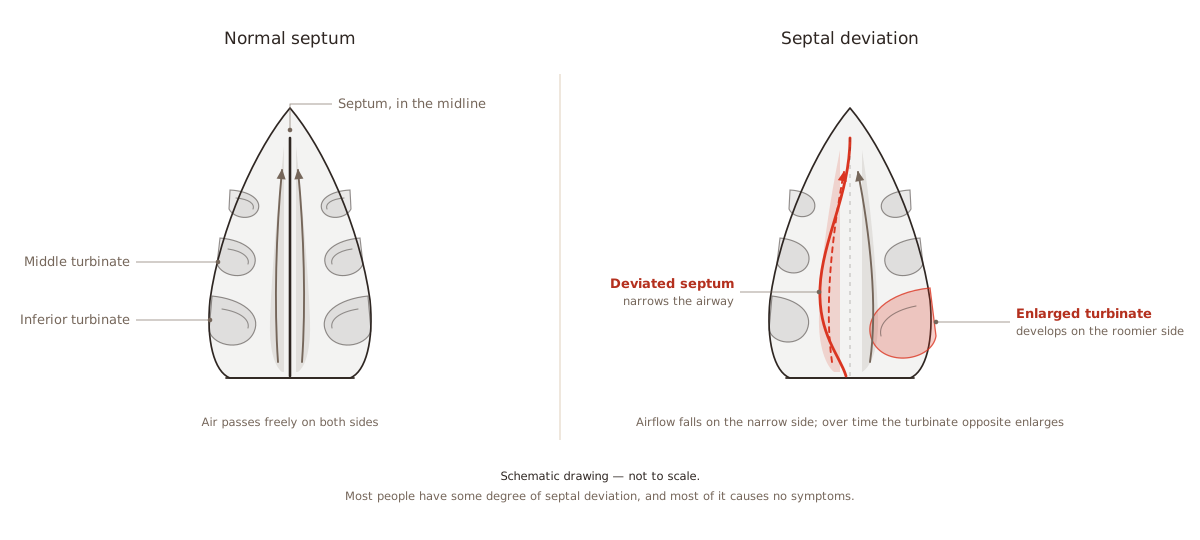
The septum is the cartilage and bone partition that divides the inside of the nose into two airways. Almost nobody has a perfectly straight septum; some degree of deviation is present in most people. The problem begins when the deviation is marked enough to restrict airflow.
A deviation may be present from birth, develop during growth, or follow an injury. A minor knock in childhood that went unnoticed often produces symptoms years later.
Symptoms
- Breathing noticeably less through one nostril than the other
- Sleeping with the mouth open; a dry mouth and sore throat in the morning
- Snoring
- Frequently recurring sinus infections
- Growing reliance on decongestant nasal sprays
- Insufficient nasal airflow during exercise
- Recurrent nosebleeds, usually from one side
None of these has to be caused by the septum. Allergic rhinitis, enlarged turbinates, adenoids and sinus disease produce a similar picture. The distinction is made by examination and endoscopy, and treatment is planned only once the source is known.
How it is performed
Every incision stays inside the nostrils; there is no incision on the face or on the bridge of the nose. The lining over the septum is lifted, the deviated cartilage and bone are removed or straightened in place, and the lining is laid back down.
The aim is not to remove the whole septum. The central portion that supports the nose is preserved; otherwise the bridge can collapse over time. Cartilage that is removed is assessed for use as graft material where needed.
If the turbinates are also enlarged, radiofrequency reduction in the same session is common. The two complement each other: even with a straightened septum, large turbinates can maintain the obstruction.
Thin silicone splints with an airway through them are usually placed at the end. They hold the septum in its new position and are generally removed within a week.
One operation, two different patients
People arrive at this page for two different reasons. One group says "I cannot breathe"; for them this is a purely functional operation and the outside of the nose does not change. The other group says "my nose looks crooked"; if there is also an external deviation, septoplasty alone will not be enough and septorhinoplasty is needed.
Which group you are in becomes clear at the examination. When the two are confused, patients do not get the result they expected: someone who has had septoplasty alone may be surprised to find the outside of their nose unchanged.
Recovery
- First 48 hours The lining is swollen, so breathing does not improve immediately and may even feel more blocked at first. This is expected.
- Week 1 Silicone splints are usually removed during this week. Most patients describe clear relief afterwards.
- Weeks 2 to 4 Crusting continues; saline spray is recommended for cleaning. Breathing opens up gradually.
- Months 2 to 3 The lining heals fully and the result settles.
These are average times; recovery varies from person to person.
Written and medically reviewed by
Ear, Nose and Throat Surgeon · Last reviewed:
Frequently asked questions
Will septoplasty change how my nose looks?
No. Septoplasty addresses only the partition inside the nose; the external outline stays as it is. If you also want the appearance changed, septorhinoplasty should be discussed.
Will there be a scar on my face?
No. All incisions are inside the nostrils.
Can the deviation come back?
After a properly performed septoplasty the corrected portion is generally stable. A new injury can change the picture again. Persistent symptoms sometimes come not from the septum but from uncorrected turbinate enlargement or from allergy.
Can it be treated without surgery?
Bone and cartilage deviation does not resolve with medication. However, if allergy or turbinate enlargement also contributes to the obstruction, medical treatment can be tried first and the need for surgery reassessed.
Is it performed in children?
Surgery is deferred where possible because the nose is still growing. If there is marked breathing difficulty, limited procedures may be considered; the decision depends on the child's age and the severity of symptoms.
Book a consultation
Let us establish the source of your complaint together, through examination and endoscopic assessment.