Rhinoplasty in Ankara
Reshaping the dorsum, the tip and the width of the nostrils so they sit in proportion with the face. Because this is done by an ENT surgeon, the septum, turbinates and nasal valve are assessed in the same operation: the aim is to change the shape without narrowing the airway.
What rhinoplasty does
Rhinoplasty reshapes the bone and cartilage framework of the nose. The structures that give the nose its outline are the same structures that carry the airway: lowering the dorsum affects the upper lateral cartilages, and rotating the tip changes the nasal valve angle. That is why the operation is not planned from the outside alone.
The examination looks at the inside of the nose as closely as the outside. An endoscope shows the position of the septum, the size of the turbinates and the width of the nasal valve. Whether your expectation fits your anatomy is discussed at that consultation.
Who it may suit
There is no single candidate profile. These are the sentences we hear most often in clinic:
- A hump on the dorsum, visible in profile
- A tip that sits low, or drops when smiling
- A nose that looks deviated relative to the midline of the face
- Nostrils that feel too wide
- A change in shape after an injury
- Nasal obstruction alongside the concern about appearance
Growth of the nose is expected to be complete, so surgery is usually left until after adolescence. Uncontrolled bleeding disorders, active infection and some systemic conditions that impair healing can delay surgery. Smoking harms tissue healing and you will be asked to stop before and after the operation.
How it is performed
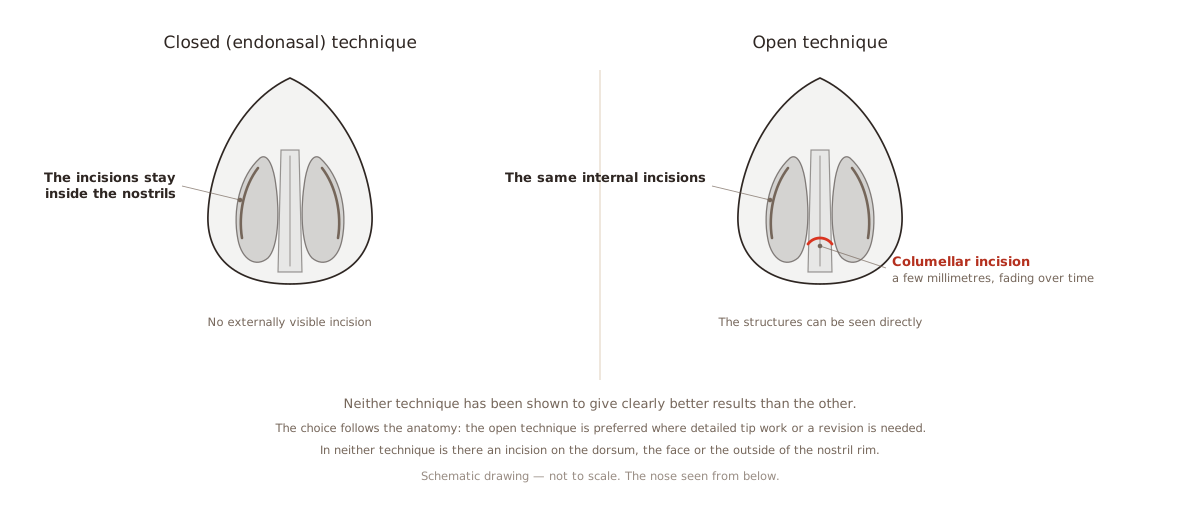
There are two approaches. In the closed (endonasal) technique every incision stays inside the nostrils. In the open technique a further incision of a few millimetres is made across the columella, the bridge of skin between the nostrils; this scar becomes difficult to see over time. The open technique gives direct sight of the structures and is preferred when detailed work on the tip is needed. Which one is chosen depends on your nose.
A dorsal hump is rasped or cut away. If the bones need narrowing, this is done with osteotomies, which are controlled fractures. The tip is shaped by repositioning the cartilages with sutures and, where needed, adding support grafts.
When a graft is needed, the first choice is usually cartilage from the septum. If the septum does not provide enough, ear cartilage can be used, and rib cartilage where stronger support is required. Which of these is likely to be needed is normally discussed before surgery.
A splint is placed on the dorsum at the end of the operation. If the septum was also worked on, thin silicone splints may be placed inside. The older type of packing that hurt on removal has largely been abandoned.
What can be changed, and what cannot
Explaining what an operation can achieve is easy. Stating its limits is done less often, but it is the only way to set expectations correctly. What follows are limits set by tissue, not by technique.
- Skin thickness. In thicker skin, fine detail at the tip shows less from the outside and swelling lasts longer. In thin skin, any irregularity underneath can become visible over time. Skin thickness cannot be changed; the operation is planned around it.
- Cartilage reserve. Where support is needed, grafts are used, and cartilage is taken from the septum first. In a nose that has been operated on before, that reserve may be depleted; ear or rib cartilage then comes into consideration.
- Facial proportions. The nose is not seen on its own but together with the chin, forehead and the midline of the face. A nose that does not suit the rest of the face will not sit right, even if it is "correct" in isolation.
- The biology of healing. How scar tissue will behave cannot be known in advance. The same technique can give different results in two people, and the result takes twelve months to settle.
- Breathing comes before appearance. An aesthetic request that would narrow the nasal valve damages the result in both respects. Such a request is declined, with the reason explained.
These limits are discussed one by one at the consultation. A target such as "that celebrity's nose" is not a realistic plan, because the same shape on different skin and a different skeleton does not give the same result.
Risks and realistic expectations
Every operation carries risk. In rhinoplasty this includes bleeding, infection, problems related to anaesthesia, temporary changes in smell and sensation, and asymmetry or irregularity appearing during healing. Some of these resolve simply; some need a second correction.
It would be wrong to give a single figure for the revision rate; what gets reported depends on what is being counted. An analysis published in JAMA Facial Plastic Surgery covering 175,842 patients across three states' hospital records found a revision septorhinoplasty rate of 3.1 per cent for operations performed in theatre. Clinical sources such as the Cleveland Clinic, which also count minor corrections and filler touch-ups, cite around 15 per cent. Most of the gap is explained by small corrections arising from aesthetic expectation.
Needing a revision does not mean the first operation failed; it reflects how difficult it is to predict tissue behaviour during healing. Visual planning can be done before surgery, but it is not a promise: the outcome is shaped by individual factors such as skin thickness and cartilage strength.
Recovery
- First 48 hours Swelling and bruising are at their most obvious. Keep the head elevated; cold compresses help. Breathing through the mouth is normal at this stage.
- Week 1 The splint and any internal silicone splints are usually removed during this week. Most of the bruising begins to fade.
- Weeks 2 to 4 Most patients return to social life. Follow the timing your surgeon gives you for glasses and for anything that strains the nose.
- Months 2 to 3 Most of the swelling resolves. Fine swelling at the tip continues, and lasts longer with thicker skin.
- Months 6 to 12 Remaining swelling resolves gradually. The nose usually takes about a year to settle into its final shape, sometimes longer.
These are average times; recovery varies from person to person.
Written and medically reviewed by
Ear, Nose and Throat Surgeon · Last reviewed:
Frequently asked questions
Is rhinoplasty painful?
Most patients describe the days afterwards as blockage and pressure rather than pain. Pain is usually controlled with simple analgesics. Pain thresholds still vary from person to person.
Will my breathing get worse?
The aim is the opposite. Because narrowing the dorsum can also narrow the internal airway, the nasal valve is supported and grafted where needed. An existing septal deviation or enlarged turbinates can be corrected in the same operation.
Are the bones broken?
If the nasal bones need narrowing, osteotomies are performed. These are controlled fractures, made under general anaesthesia, so you neither hear nor feel them.
When can I exercise?
Light activity such as walking is usually allowed early. Weight training, running and especially contact sports require a considerably longer wait. Your surgeon sets the timing according to the extent of your operation.
Can I wear glasses?
If the bones were worked on, there is a period during which glasses should not press on the dorsum. Contact lenses or a forehead-supported frame may be suggested. Confirm the timing with your surgeon.
I am travelling from abroad. How long should I stay?
Usually a few days before surgery for examination and pre-operative tests, and about a week afterwards for the first check and splint removal. Total time depends on what is planned, so please discuss it before booking travel.
Do you use imaging simulation before surgery?
Visual work can be done to discuss expectations. It is not a promise: the outcome is determined by individual factors such as skin thickness and cartilage structure.
I smoke. Is that a problem?
Smoking impairs tissue healing. You will be asked to stop, or at least to pause, before and after surgery. Discuss the timing with your surgeon.
Book a consultation
Let us establish the source of your complaint together, through examination and endoscopic assessment.