
Adenoids and Tonsils: When Is Surgery Needed?
Not every large tonsil is removed and not every snoring child needs surgery. The thresholds the guidelines set, and how large the benefit really is.
Op. Dr. Yaşar Okan Akın · · 8 min read
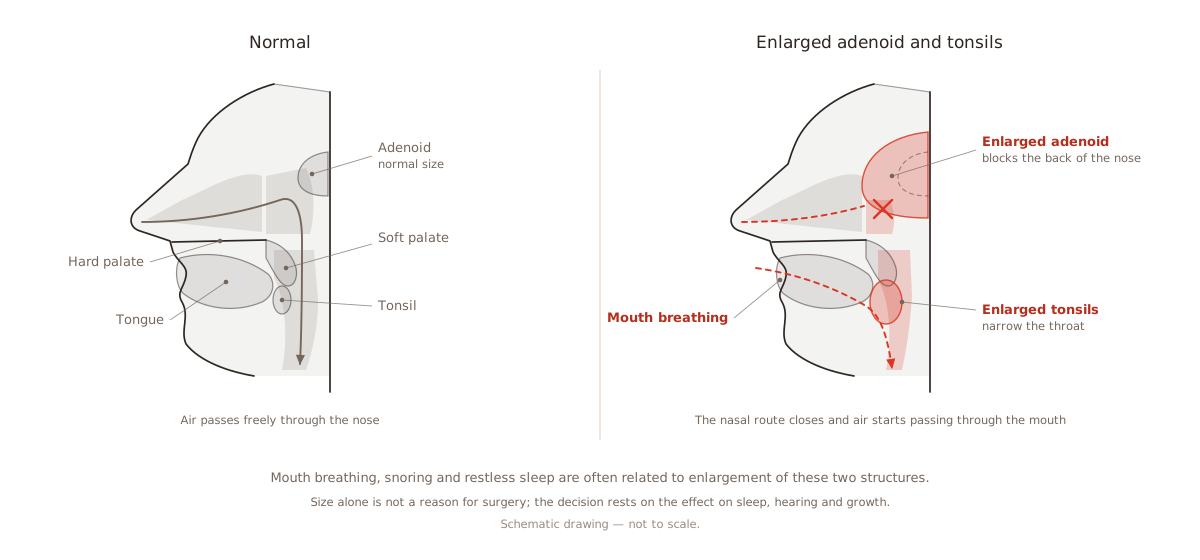
The purpose of this article is not to recommend surgery, but to explain when it is needed and when it is not, in terms a parent can act on.
What is the adenoid?
The adenoid is immune tissue sitting in the space behind the nose. Everyone has one.
The key point: the adenoid naturally grows and naturally shrinks. It reaches its largest size at around three to seven years of age, then begins to regress on its own, and by adolescence is usually of no clinical significance.
So "there is an adenoid" does not mean "surgery is needed".
When does it become a problem?
When the adenoid clearly blocks the back of the nose, this picture appears:
- Inability to breathe through the nose, constant open-mouth posture
- Snoring, pauses in breathing during sleep
- Restless sleep, night sweating, frequent changes of position
- Postnasal drip, constant throat clearing
- Blockage of the Eustachian tube → fluid in the middle ear → conductive hearing loss and recurrent ear infections
The last one is what parents most often miss: the child is not "not hearing", it is more as though they are hearing through a curtain. Turning the television up, not responding when called, appearing distracted in class can all point to it.
What happens if it is left?
Long-term mouth breathing has a cost:
- Changes in facial development (a lengthened face, open-mouth posture)
- Malocclusion, a narrowed palate
- Growth delay related to disturbed sleep quality
- Attention and behaviour problems, poorer school performance
- Persistent bedwetting
These are the accompanying conditions the American Academy of Otolaryngology also asks to be weighed in the surgical decision.
Tonsil surgery: the guideline thresholds
The 2019 guideline of the American Academy of Otolaryngology sets clear numerical thresholds for recurrent throat infection. The easy way to remember them is "7 / 5 / 3":
- 7 episodes in the past year, or
- 5 episodes a year for 2 years, or
- 3 episodes a year for 3 years
If these thresholds are not met, the guideline's strong recommendation is watchful waiting — that is, not surgery.
Situations that argue for surgery even below the threshold:
- Allergy or intolerance to multiple antibiotics
- PFAPA syndrome (periodic fever)
- A history of more than one peritonsillar abscess
Sleep-disordered breathing is a separate indication and is assessed independently of the number of infections.
When is a sleep study needed?
The guideline also lists when polysomnography should be requested before surgery:
- Children under 2 years
- Obesity, Down syndrome, craniofacial anomaly, neuromuscular disease, sickle cell disease
- When the severity of symptoms is unclear
- When examination findings do not match what the family describes
That last one matters: if the tonsils look small but the family describes serious pauses in breathing, trust the test rather than the examination.
To be honest: the size of the benefit is debated
A site that omits this section is giving you incomplete information.
In children (Cochrane review, 987 children): the gain from tonsillectomy for recurrent throat infection in the first year averaged 0.6 episodes — and one of those episodes was the post-operative pain itself. Days with a sore throat fell from 23 to 18. In more mildly affected children, the surgical group did worse than the control group.
In adults (NATTINA trial, Lancet 2023, 453 patients): here the picture is clearer — total days with a sore throat were 47% lower in the surgical group and quality-of-life scores improved significantly. However, 19% of patients had post-operative bleeding in the same trial.
What this means: tonsillectomy is not the answer to every recurrent sore throat. It is worthwhile in children who meet the thresholds and genuinely fall ill often; in a mild picture, waiting is the better choice.
For the sleep-disordered breathing indication the picture is different — there the benefit is far clearer.
After surgery — the guideline's explicit rules
These bear directly on safety and parents should know them:
- A single dose of corticosteroid during surgery is strongly recommended (it reduces nausea and pain)
- Ibuprofen and/or paracetamol are recommended for pain
- Antibiotics should not be given unless there is another indication (strong recommendation)
- Codeine, and any medicine containing codeine, must not be given — fatal respiratory depression has been reported in children
- Children under 3 or with severe sleep apnoea should be observed in hospital
The last two are the most critical safety points on this page.
"Will it grow back?"
The most frequent question.
Adenoid: reported regrowth rates in the literature range from 1.3% to 26% — that wide spread depends on technique. The classical curettage method has been shown to leave tissue behind in about 60% of patients. With endoscopically guided surgery the rate falls markedly.
Regrowth risk is higher when surgery is performed at a very young age and in children with reflux.
Tonsils: when removed completely by the classical method, regrowth is very rare. In partial procedures that preserve the capsule (tonsillotomy) regrowth is more common — but pain and bleeding risk are lower. Which method is chosen depends on the indication.
Frequently asked questions
Are tonsils not needed for immunity? They are part of the immune system, but not the only part. They belong to a ring of lymphoid tissue in the throat and nose, and removal has not been shown to weaken immunity measurably. A persistently infected tonsil, by contrast, becomes a source rather than a defence.
My child snores. Is surgery unavoidable? No. Simple snoring and pauses in breathing during sleep are different things. The distinction is made by examination and, where needed, a sleep study.
Are the adenoid and tonsils removed together? It depends. If the problem is only nasal obstruction, the adenoid alone may be removed. Where there is sleep apnoea, both are usually assessed together.
At what age can it be done? Age alone is not decisive; the severity of symptoms is. Under two years a sleep study is requested beforehand and hospital observation is needed afterwards.
Will grommets be needed too? They come into consideration when fluid persists in the middle ear. The guideline notes that removing the adenoid at the same time as inserting grommets may reduce later recurrent ear problems in children with adenoid-related symptoms, or in children aged four and over.
This content is for general information only; please consult your doctor for diagnosis and treatment. Results of any surgical or interventional procedure vary from person to person.
Sources
- AAO-HNS. Clinical Practice Guideline: Tonsillectomy in Children (Update). 2019. https://www.entnet.org/quality-practice/quality-products/clinical-practice-guidelines/tonsillectomy-in-children-update/
- Tonsillectomy for chronic/recurrent acute tonsillitis. Cochrane CD001802. https://www.cochrane.org/evidence/CD001802_surgical-removal-tonsils-tonsillectomy-chronic-or-recurrent-acute-tonsillitis
- NATTINA: tonsillectomy versus conservative management in adults. Lancet 2023. https://doi.org/10.1016/S0140-6736(23)00519-6
- AAO-HNS. Clinical Practice Guideline: Tympanostomy Tubes in Children (Update). 2022.
- Adenoid regrowth: meta-analysis. https://pubmed.ncbi.nlm.nih.gov/32896343/
Written and medically reviewed by
Ear, Nose and Throat Surgeon · Last reviewed:
Book a consultation
Let us establish the source of your complaint together, through examination and endoscopic assessment.