
Dizziness and Loose Ear Crystals (BPPV)
For BPPV, the commonest cause of dizziness, the guidelines argue against drug treatment. The correct treatment takes a few minutes in the clinic.
Op. Dr. Yaşar Okan Akın · · 7 min read
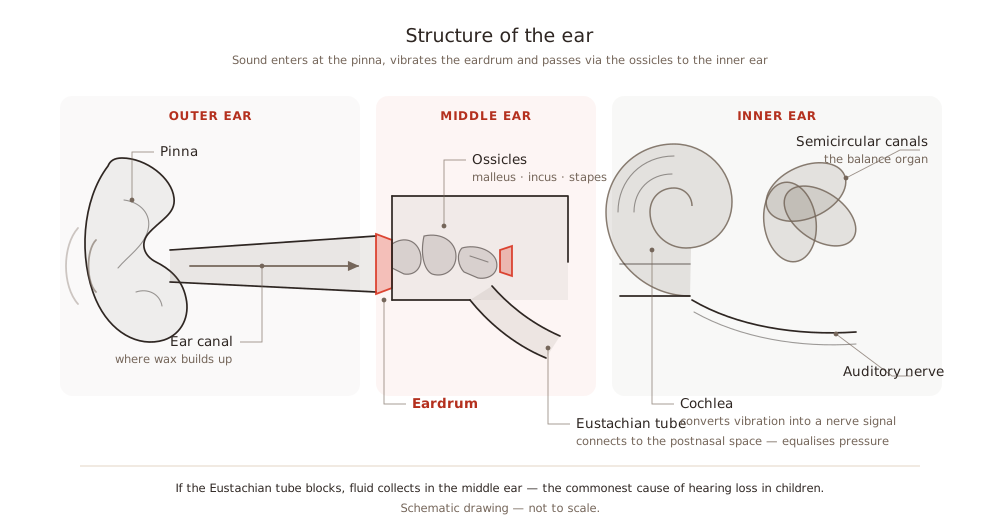
Dizziness is commonly put down to blood pressure, a neck problem or anaemia, and treated with medication. In fact the commonest cause of dizziness lies in the inner ear, and for its most frequent type the guidelines explicitly argue against the use of drugs.
First, tell three conditions apart
The key to the right diagnosis lies in a single question: how long does an attack last?
| BPPV (loose crystals) | Ménière's | Vestibular neuritis | |
|---|---|---|---|
| Duration | Seconds (under a minute) | 20 minutes – 12 hours | Days (continuous) |
| Trigger | Head position — lying down, rolling over, looking up | Spontaneous | Spontaneous |
| Hearing | Normal | Fluctuating loss + tinnitus + fullness | Normal |
| Course | In attacks | In attacks | Usually a single attack |
Which of the three a patient's "I feel dizzy" belongs to can usually be settled with just two questions: how many seconds or minutes does it last, and what are you doing when it starts.
BPPV — the commonest cause
The everyday name for it, "loose crystals", is actually quite accurate. Microscopic calcium crystals inside the balance organ of the inner ear come free and stray into one of the semicircular canals. Movement of the head then moves the fluid in a way that produces a false signal, and the brain believes you are spinning when you are not.
The typical story: an intense spinning sensation that starts suddenly while rolling over in bed, lying down, or lifting the head to reach a shelf, and lasts seconds. Then it passes. Repeating the same movement brings it back.
Diagnosis: the Dix-Hallpike manoeuvre
It is done in the clinic and needs no equipment. With the patient sitting, the head is turned 45 degrees and the patient is laid back quickly, with the neck slightly extended. If crystals are in the canal, a characteristic flicker of the eyes (nystagmus) appears.
The test shows which ear and which canal is affected. For the horizontal type, the supine roll test is used instead.
Three things the guideline says should not be done
This section conflicts with common practice, which is exactly why it is worth knowing. In patients who meet the diagnostic criteria and have no discordant findings, the BPPV guideline of the American Academy of Otolaryngology says:
- Imaging (MRI, CT) should not be performed
- Vestibular testing should not be requested
- Vestibular suppressant drugs should not be used routinely — antihistamines, benzodiazepines and similar anti-dizziness medicines
The third is the most important. These drugs can temporarily reduce acute nausea, but they do not treat BPPV, and used long term they delay the brain's adaptation to the situation (central compensation).
Treatment: the manoeuvre
The guideline's strongest recommendation (grade A evidence): in posterior canal BPPV, a canalith repositioning manoeuvre (the Epley manoeuvre) should be performed, or the patient should be referred to a clinician who can perform it.
The manoeuvre is a sequence of head positions that moves the crystals out of the canal they have strayed into and back to where they are harmless. It takes a few minutes in the clinic, needs no medication, and produces marked improvement in most patients in a single session.
Another rule that changed: you do not need to "sleep upright for three days"
Patients used to be told to sleep upright for a few days after the manoeuvre and to avoid moving the head. The guideline finds this unnecessary, with a strong recommendation: postural restrictions should not be advised after the manoeuvre.
Follow-up: the guideline recommends reassessment within one month of the manoeuvre.
Ménière's disease
It is diagnosed by international consensus criteria. Definite Ménière's requires:
- At least 2 spontaneous vertigo attacks, each lasting between 20 minutes and 12 hours
- Sensorineural hearing loss at low to medium frequencies in the affected ear, documented by a hearing test
- Fluctuating auditory symptoms in the same ear — hearing, tinnitus or fullness
- Not better explained by another diagnosis
The second point is critical: a hearing test is essential for a diagnosis of Ménière's. Diagnoses made on history alone are frequently wrong.
Vestibular neuritis
Inflammation of the balance nerve. Severe dizziness, nausea and unsteadiness that begin suddenly and last for days. Hearing is normal, which is the most important feature distinguishing it from Ménière's.
To be honest about treatment: corticosteroids are widely used, but the evidence is weak. In a meta-analysis pooling 8 studies, the steroid group showed improvement in balance testing at one month, but by 12 months no difference remained between the groups; no significant difference was found in symptom scores at 1, 6 or 12 months. The review's conclusion: the evidence is insufficient to support the use of corticosteroids in acute vestibular neuritis in adults.
The approach showing the most consistent benefit is vestibular rehabilitation — balance exercises. Short-term medication may be used for nausea in the acute phase, but prolonged use of suppressant drugs delays recovery.
⚠️ When to go to the emergency department
If dizziness is accompanied by any of the following, go to an emergency department without waiting:
- Severe, sudden-onset headache, neck stiffness
- Double vision, loss of vision, difficulty speaking, difficulty swallowing
- One-sided weakness or numbness, facial palsy
- Being unable to stand or walk without support — the strongest bedside sign of a problem originating in the brain
- Sudden hearing loss together with dizziness
- Altered consciousness
These symptoms suggest the dizziness may come from the brain rather than the inner ear, and time is critical.
Common misconceptions
| Misconception | The reality |
|---|---|
| "Dizziness comes from blood pressure" | Most vertigo attacks originate in the inner ear |
| "It's my neck problem" | Dizziness of cervical origin is a contested and rare diagnosis |
| "Loose crystals are treated with medication" | The guideline is against suppressant drugs; the treatment is a manoeuvre |
| "I must sleep upright for three days afterwards" | Strong recommendation: postural restrictions are not needed |
| "I need an MRI" | Imaging is not recommended in typical BPPV |
Frequently asked questions
Is the manoeuvre painful? No, though brief but intense dizziness and nausea can occur during it. That is in fact a sign the diagnosis is right.
Does one session fix it? Most patients improve markedly. It is repeated if needed. Review within one month is recommended.
Does it come back? BPPV can recur. When it does, the same manoeuvre is effective again.
Can I do it myself at home? The manoeuvre has to be applied to the right ear and the right canal; done on the wrong side it can make symptoms worse. The diagnosis has to come first.
Which specialty should I see for dizziness? Dizziness originating in the inner ear falls within ear, nose and throat. If any of the emergency symptoms above are present, go straight to an emergency department.
This content is for general information only; please consult your doctor for diagnosis and treatment.
Sources
- AAO-HNS. Clinical Practice Guideline: Benign Paroxysmal Positional Vertigo (Update). 2017. https://doi.org/10.1177/0194599816689667
- Diagnostic criteria for Ménière's disease — Bárány Society consensus. J Vestib Res 2015. https://doi.org/10.3233/VES-150549
- Corticosteroids for vestibular neuritis: systematic review and meta-analysis. Otolaryngol Head Neck Surg 2021. https://doi.org/10.1177/0194599820982910
Written and medically reviewed by
Ear, Nose and Throat Surgeon · Last reviewed:
Book a consultation
Let us establish the source of your complaint together, through examination and endoscopic assessment.