
Enlarged Turbinates and Radiofrequency Reduction
Turbinates are not surplus tissue. They warm and humidify the air, which is why modern surgery reduces their volume instead of removing them.
Op. Dr. Yaşar Okan Akın · · 7 min read
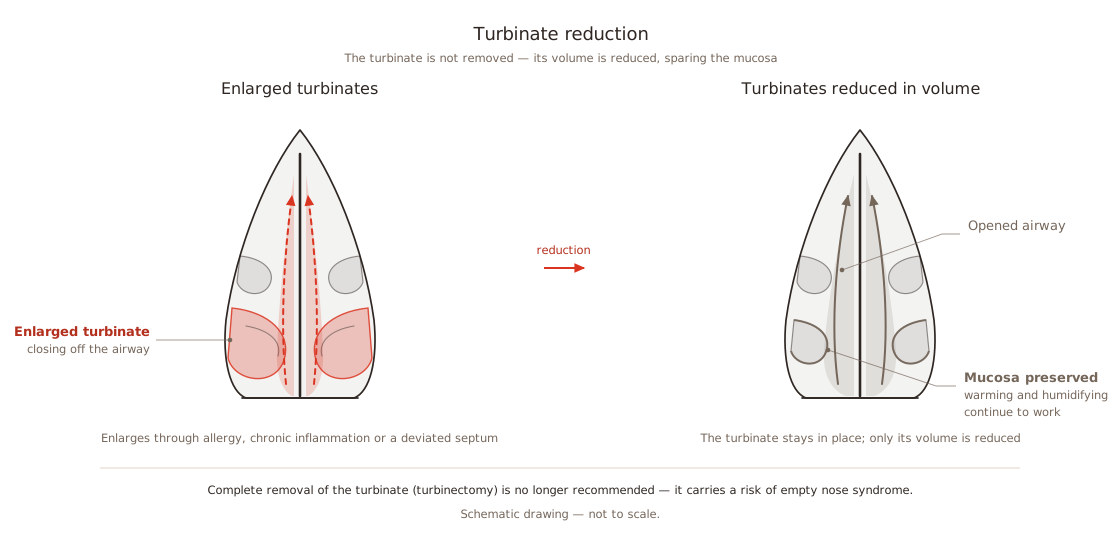
Let us clear up a confusion first, because these two structures are mixed up more often than any others in clinic:
- The turbinates (conchae) are the scroll-shaped structures projecting from the side walls inside the nose.
- The adenoid is immune tissue sitting behind the nose, at the back of the nasal cavity.
Different structures, different problems, different treatments. In Turkish the everyday names for them, burun eti and geniz eti, sound almost identical, which is why patients frequently arrive believing they have been told about one when they were told about the other.
What do the turbinates do?
The answer to this question dictates the entire treatment approach.
The inferior turbinate is not a passive lump of tissue. It is an erectile structure under autonomic nervous control whose blood flow can change within seconds. Its functions:
- Bringing inhaled air close to body temperature
- Humidifying it to nearly 100%
- Filtering dust and particles
- Creating turbulence in the airstream so that more air contacts the mucosa
There is also a phenomenon called the nasal cycle: the turbinates swell and shrink in alternation, typically over cycles of two to six hours. This is why the lower nostril blocking when you lie on your side is normal, not a sign of disease.
Why do they enlarge?
- Allergic rhinitis and non-allergic (vasomotor) rhinitis
- Compensatory enlargement — when the septum deviates to one side, the turbinate on the roomier side grows to fill the space
- Rhinitis medicamentosa — dependence on decongestant sprays (see below)
- Hormonal causes (pregnancy, thyroid disease), smoking, environmental irritants
The spray cycle: very common, and very important
Vasoconstrictor nasal sprays bought over the counter (oxymetazoline, xylometazoline) open the nose within minutes. The problem: used for longer than three to five days, the mucosa becomes dependent on them. When the spray wears off the nose is more blocked than before, the person sprays more often, and the cycle feeds itself. This picture is called rhinitis medicamentosa.
Patients who arrive saying "I have been using a spray for years and cannot stop" are not rare.
Important: this on its own is not a reason for surgery. The spray must first be stopped and the mucosa allowed to recover with appropriate treatment. Otherwise the cycle continues even after an operation.
Methods of reduction
The main methods in use are radiofrequency thermal ablation (applied beneath the mucosa), microdebrider-assisted turbinoplasty, submucosal resection, cautery and lateralisation.
Partial or total removal of the turbinate (turbinectomy) is no longer recommended. The reason is in the next section.
Radiofrequency or microdebrider?
A 2025 meta-analysis covering 15 randomised trials and 789 patients compared the two:
| Outcome | Finding |
|---|---|
| Post-operative bleeding | Radiofrequency clearly better — risk 3.84 times higher with the microdebrider |
| Improvement in nasal obstruction | No significant difference at any time point |
| Result at 12 months | A trend favouring the microdebrider, but not statistically significant |
| Discharge, headache, sneezing | No difference |
The study's conclusion: both methods are effective; radiofrequency reduces bleeding risk, and the microdebrider may offer a potential long-term advantage.
So the evidence-based answer to "which is better" is: it depends. The method is chosen according to the structure of the turbinate, any procedures being done at the same time, and bleeding risk.
Is the effect permanent?
The honest answer: most studies carry 12 months of follow-up or less. Effectiveness has been shown over that period. Reliable longer-term data are limited.
The clinical reality is this: if the underlying cause, allergy above all, continues, symptoms may return over time and the procedure may need to be repeated. That is not a failure, it is the nature of the disease. Treating the allergy has a direct effect on how long the surgical result lasts.
Empty nose syndrome: the thing actually worth fearing
The account of "I had my turbinates cauterised and it made things worse" is a common one. It has a medical counterpart, and its name is empty nose syndrome.
What it is: a difficult-to-reverse condition arising after excessive turbinate reduction or removal.
The paradox: on examination the nose is completely open — endoscopy shows a wide, roomy cavity. Despite that, the patient describes intense blockage, dryness and a sense of suffocation.
Why it happens: when the turbinates are diminished, turbulence in the airstream is lost. The mucosa dries out and its structure changes; the sensory nerve endings that detect airflow and its coolness are damaged. The brain starts receiving a "no air is getting through" signal, when in fact a great deal is.
How common is it: there are no reliable frequency data in the literature. Reviews on the subject state plainly that the precise incidence in turbinate reduction patients is unknown. For that reason no figure is given here.
Procedures that raise the risk: total or partial turbinectomy, aggressive submucosal resection. Safer ones: mucosa-sparing, submucosal approaches.
There is only one form of prevention: performing turbinate reduction only when it is genuinely clinically needed, and preserving the mucosa and the turbinate itself.
This is why the turbinate today is not removed; its volume is reduced. The surgical aim is not to eliminate the turbinate but to make room while keeping its function.
Common misconceptions
| Misconception | The reality |
|---|---|
| "Turbinates and adenoids are the same thing" | Different structures. Turbinates sit inside the nose; the adenoid sits behind it |
| "Just take the turbinate out and let me breathe" | Carries the risk of empty nose syndrome; no longer recommended |
| "Once cauterised, it never grows back" | It can recur if the allergy continues |
| "It is better if it is done with a laser" | No significant difference between methods has been shown for the obstruction outcome |
| "If a spray opens it, no surgery is needed" | A vasoconstrictor spray used beyond three to five days creates a cycle of dependence |
Frequently asked questions
Why is it done together with septoplasty? When the septum deviates, the turbinate on the roomier side enlarges. If only the septum is straightened, that side may still feel blocked. The two are therefore often planned together.
Is the procedure painful, and how long does it take? Radiofrequency is usually a short procedure that can be done under local anaesthesia. Duration and choice of anaesthesia depend on whether other procedures are being carried out at the same time.
Will my nose open immediately after surgery? No. In the first few days the swelling caused by the procedure can temporarily increase the blockage. Improvement becomes clear over the following weeks.
I was told my turbinates are large but I have no symptoms. Should I have surgery? No. As with a deviated septum, the decision is based on symptoms, not on the picture.
This content is for general information only; please consult your doctor for diagnosis and treatment. Results of any surgical or interventional procedure vary from person to person.
Sources
- Radiofrequency ablation versus microdebrider-assisted turbinoplasty: systematic review and meta-analysis. Egypt J Otolaryngol 2025. https://link.springer.com/article/10.1186/s43163-025-00979-0
- The inferior turbinate: an autonomic organ. Am J Otolaryngol. https://pubmed.ncbi.nlm.nih.gov/30193745/
- Empty nose syndrome — review. Plast Aesthet Res. https://www.oaepublish.com/articles/2347-9264.2023.110
Written and medically reviewed by
Ear, Nose and Throat Surgeon · Last reviewed:
Book a consultation
Let us establish the source of your complaint together, through examination and endoscopic assessment.