Rhinoplasty Recovery: What to Expect, Week by Week
When does the splint come off, when does bruising fade, when can you go back to work, and when is the result final? A realistic timeline.
Op. Dr. Yaşar Okan Akın · · 8 min read
What usually makes the decision hard is not the operation itself but the uncertainty about what follows. This article exists to make that as concrete as possible.
The timeline
| Time | What happens |
|---|---|
| 0–48 hours | Any internal dressing is removed. Sleep with the head elevated. Swelling and bruising tend to increase. |
| ~7 days | The external splint comes off. This is the psychological turning point of the process. |
| 1–2 weeks | Most of the bruising fades. Most patients return to work. |
| 2–4 weeks | Most everyday activities resume. |
| 4 weeks | The period during which glasses must not rest on the dorsum ends. |
| 4–6 weeks | Return to light exercise; heavy lifting is permitted again. |
| 3 months | Roughly 90% of the swelling has resolved. |
| 12 months | The final result. Swelling at the tip is the last to go. |
| ≥12 months | The minimum wait before considering a revision. |
These are averages and they vary considerably from person to person. Skin thickness, the extent of what was done and individual healing speed can lengthen or shorten the process.
The thing that surprises people most: the result takes 12 months
When the splint comes off your nose is swollen, and what you see then is not the final result. This is the single most common source of patient dissatisfaction, because the expectation was set wrongly.
The tip in particular is the slowest area to settle. In patients with thicker skin it can take even longer.
This is why revision is only discussed after twelve months. Decisions made earlier are made about a result that has not yet settled.
Practical things that help
- Keep your head elevated when lying down; it noticeably reduces swelling
- In the early period prefer a bath to a shower, to keep the splint dry
- Do not blow your nose
- Open your mouth when you sneeze
- Avoid exaggerated facial expressions
- Eat enough fibre to avoid constipation; straining raises pressure inside the nose
- Wear front-buttoning clothes rather than anything pulled over the head
- Reduce salt; it increases swelling
- Sun protection (SPF 30+) — sun exposure after surgery can cause lasting pigmentation
Open or closed technique? What the evidence says
This is the topic that attracts the most marketing language online. The reality:
A systematic review and meta-analysis published in 2025, pooling 20 studies and 1,067 patients (539 open / 528 closed), found no significant difference between the two techniques in:
- Operating time
- Aesthetic satisfaction scores
- Breathing function scores
- Swelling and bruising at day seven
- Complication rates
The authors' conclusion: open and closed rhinoplasty techniques show similar effectiveness, and the choice should be made according to the patient's needs and the surgeon's experience.
An honest caveat: heterogeneity between the studies in that meta-analysis was very high (I² = 99%). That means the pooled result is statistically weak. The correct phrasing is: the evidence does not show either technique to be superior. Saying "the evidence proved they are equal" would be wrong.
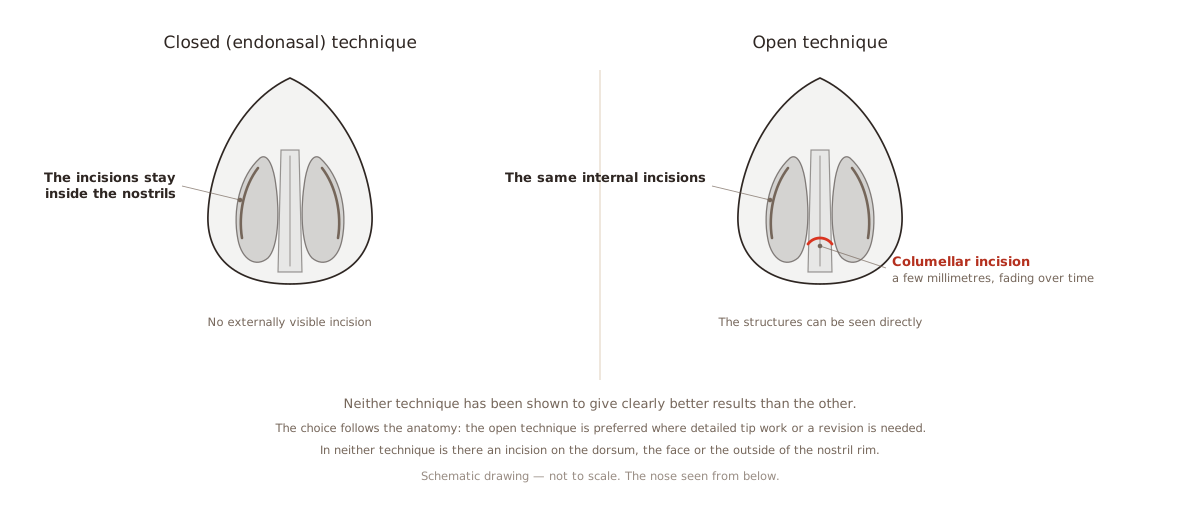
In practice: the open technique adds a small incision across the columella, the strip of skin between the nostrils, and gives the surgeon full sight of the internal structures. It is preferred for complex tip deformities, revision cases and situations needing grafts. The closed technique leaves no external incision and may produce less swelling. The choice follows the anatomy, not fashion.
What is preservation rhinoplasty?
In the classical approach the dorsal hump is cut away. In preservation rhinoplasty the roof of the dorsum is kept intact and the height is reduced from underneath, through the septum and the bony base, lowering the dorsum as a unit.
A systematic review of 30 studies and 5,967 patients found satisfaction scores markedly improved. But it should be read carefully: the technique tends to be chosen for patients with smaller humps, so the good results may partly reflect patient selection.
A comparative review published in 2026 (5 studies, 556 patients) found no significant difference in aesthetic outcome at twelve months between preservation and classical technique; breathing measurements were preserved in both groups.
The honest summary: preservation rhinoplasty appears safe and functionally equivalent to the classical technique. It may be advantageous in selected patients. There is not yet evidence to call it superior.
Piezo (ultrasonic) rhinoplasty
This means shaping the bone with an ultrasonic vibrating tip rather than a chisel and mallet. The theoretical advantage is that it can cut bone without damaging soft tissue and vessels, and that the fracture line is more controlled.
Some studies report less swelling and bruising in the early period; results vary between studies. No effect size is quoted here because the available meta-analyses do not agree.
Revision rates — the real figures
From an analysis published in JAMA Facial Plastic Surgery covering 175,842 patients across three states' hospital records:
- Overall revision septorhinoplasty rate: 3.3%
- Revision after primary septorhinoplasty: 3.1%
- Further revision after a revision septorhinoplasty: 11.0%
- Median time to revision: 1.2 years
The third figure shows why revision surgery is considerably harder than a first operation: scar tissue, altered anatomy and a reduced cartilage reserve.
This is the clearest answer to why planning the first operation correctly matters so much.
Why do you see much higher figures elsewhere? Because the number depends on what is being counted. The analysis above counts only coded revisions performed in theatre. Clinical sources such as the Cleveland Clinic, which also include minor corrections and filler touch-ups, cite around 15%. Neither figure is wrong; they measure different things. Small corrections arising from aesthetic expectation fill most of the gap.
Two further details from the same analysis are useful when deciding: the rate is lowest for septoplasty alone at 2.5%, and highest where rib cartilage grafts are used at 21.5%. The likelihood of revision tracks the extent of the operation.
Frequently asked questions
How long does the operation take? It depends on the extent of the work; septorhinoplasty is usually around 1 to 1.5 hours.
When can I go back to work? Most patients with desk-based work return within one to two weeks. Physically demanding work takes longer.
When can I exercise? Light exercise usually after four to six weeks. Contact sports and anything carrying a risk of a blow to the nose require a much longer wait.
Can I wear glasses? Usually four weeks, so that no weight rests on the dorsum. Alternatives are discussed for that period.
I smoke. Is that a problem? Yes. Smoking impairs tissue healing and blood supply. Stopping before and after surgery is strongly advised.
What if I am not happy with the result? The final result settles at twelve months, and revision is not planned before then. That wait exists to prevent an unnecessary second operation: as the swelling resolves, many concerns disappear on their own.
This content is for general information only; please consult your doctor for diagnosis and treatment. Results of any surgical or interventional procedure vary from person to person.
Sources
- Outcomes of Open Versus Closed Rhinoplasty: A Systematic Review and Meta-Analysis. PRS Global Open 2025. https://doi.org/10.1097/GOX.0000000000007047
- Dorsal Preservation Rhinoplasty: A Systematic Review. Aesthetic Plast Surg 2023. https://link.springer.com/article/10.1007/s00266-023-03345-8
- Preservation versus conventional rhinoplasty: comparative review. Frontiers in Surgery 2026. https://www.frontiersin.org/journals/surgery/articles/10.3389/fsurg.2026.1788643/full
- Revision Rates and Risk Factors of 175 842 Patients Undergoing Septorhinoplasty. JAMA Facial Plast Surg 2016. https://doi.org/10.1001/jamafacial.2015.2194
- Mayo Clinic — Rhinoplasty. https://www.mayoclinic.org/tests-procedures/rhinoplasty/about/pac-20384532
- Cleveland Clinic — Rhinoplasty. https://my.clevelandclinic.org/health/treatments/11011-rhinoplasty
Written and medically reviewed by
Ear, Nose and Throat Surgeon · Last reviewed:
Book a consultation
Let us establish the source of your complaint together, through examination and endoscopic assessment.