
Snoring and Apnoea: What Nasal Surgery Solves
Nasal surgery alone does not cure sleep apnoea. But it markedly improves CPAP tolerance, and for most patients that is the real fix.
Op. Dr. Yaşar Okan Akın · · 8 min read
There is a great deal of overstated promise on this subject online. This article sets out what nasal surgery actually does in sleep apnoea, and what it does not, based on current evidence.
First, a distinction: snoring and sleep apnoea are not the same thing
Snoring is the vibration of soft tissue in the upper airway as air passes over it. It is disruptive, but on its own it is not a disease.
Obstructive sleep apnoea adds to that:
- Breathing that stops, completely or partly
- Falling blood oxygen
- An arousal response from the brain
That cycle repeats dozens, sometimes hundreds of times a night.
This distinction can only be made with a sleep study. How loudly a person snores says nothing about whether they have apnoea.
How is severity measured?
The AHI (Apnoea–Hypopnoea Index) is the number of breathing pauses per hour of sleep:
| AHI | Classification |
|---|---|
| 5 – 15 | Mild |
| 15 – 30 | Moderate |
| > 30 | Severe |
Home test or laboratory test?
The guideline of the American Academy of Sleep Medicine:
- In uncomplicated adults at risk of moderate to severe apnoea, either a home sleep apnoea test (HSAT) or a laboratory study (polysomnography) may be used.
- A laboratory study is mandatory in these situations: significant heart or lung disease, neuromuscular disease affecting the respiratory muscles, suspected hypoventilation, chronic opioid use, a history of stroke, or severe insomnia.
- And, most usefully in practice: if a home test comes back negative, inadequate or inconclusive, a laboratory study should be performed rather than repeating the home test.
That last point is worth knowing: if you are saying "I had a home test, it showed nothing, but my symptoms continue", the process is not finished.
The role of the nose, and the honest answer
Here is the critical section.
Nasal surgery (septoplasty, turbinate reduction, valve repair) does not on its own treat sleep apnoea.
An expert consensus report published in 2026 states it plainly: nasal surgery does not consistently lower AHI scores.
Some studies do report a statistically significant fall in AHI, but that fall is usually not large enough to resolve the disease. "A significant reduction" and "a cure" are different things.
So what is nasal surgery good for?
This is where the evidence is strongest, and it matters clinically:
1. It dramatically improves CPAP tolerance. In patients unable to tolerate CPAP, device acceptance after nasal surgery rose from 42% to 93%.
2. It lowers the CPAP pressure needed. An average reduction of 2 to 3 cm H₂O. Lower pressure means more comfortable use.
3. It extends the time the device is actually worn. In one study, nightly use rose from 0.5 hours to roughly 5 hours. An average of +1.5 hours a night and a +17% increase in adherence have been reported.
4. It improves daytime sleepiness and quality of life.
5. It improves the success of oral appliances (mandibular advancement devices).
6. It can reduce snoring.
The consensus recommendation: assessment of nasal patency should become routine before and during CPAP therapy.
What this means in practice
CPAP is the most effective treatment for sleep apnoea, as long as it is used. A patient who collects the device and leaves it in a cupboard has not been treated.
Fitting a mask to someone whose nose is blocked is like trying to blow air through a blocked pipe. Once the nose is open the device becomes tolerable and the actual treatment starts working.
So nasal surgery here is not the treatment for the apnoea; it is the step that lets the treatment work. That is not a minor role. For most patients it is the difference between treatment succeeding and failing.
The airway does not narrow at a single point
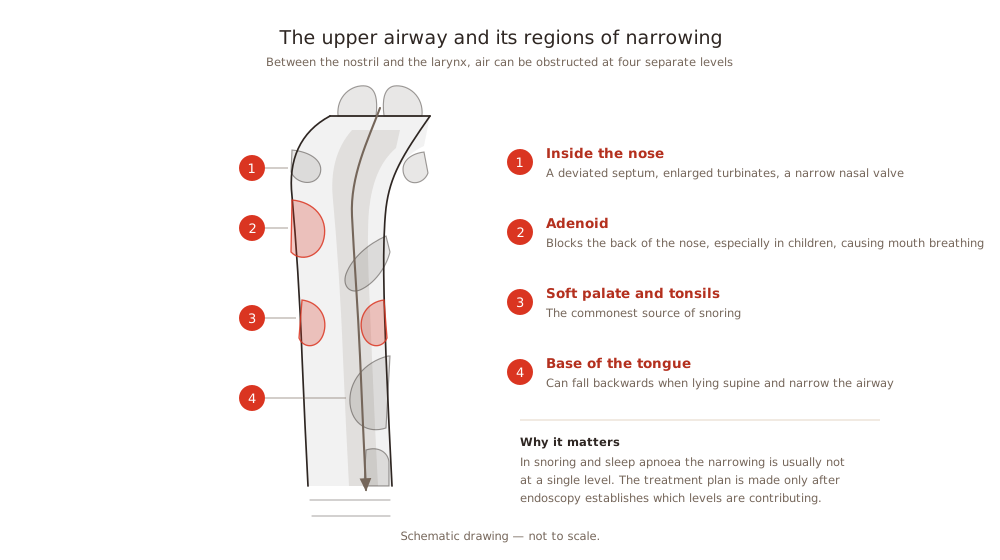
Obstruction in the upper airway can occur at four separate levels:
- Inside the nose — a deviated septum, enlarged turbinates, a narrow nasal valve
- The adenoid region — particularly in children
- The soft palate and tonsils — the commonest source of snoring
- The base of the tongue — falling backwards when lying supine
In most patients more than one level contributes. That is why a treatment plan can only be built after endoscopic assessment. Two patients who both arrive saying "I snore" should not be offered the same operation.
In children the picture is different
The first-line treatment for sleep apnoea in a child is adenoid and tonsil surgery, and here surgery genuinely is curative.
Even so, honesty is needed: according to a 2024 guideline, up to 40% of children may have some degree of continuing breathing pauses despite surgery. Risk factors are a high starting AHI, obesity, craniofacial or genetic conditions, and chronic heart or lung disease.
Options then considered include rapid palatal expansion, drug-induced sleep endoscopy to locate the site of narrowing, tongue-base surgery, and CPAP.
Frequently asked questions
I only snore, I don't have apnoea. Do I need surgery? In simple snoring, lifestyle measures come first (weight, sleeping on your side, avoiding alcohol and sedatives) along with relieving nasal obstruction. The decision to operate depends on how severe the complaint is and where the narrowing sits.
Can I have surgery without a sleep study? Not if sleep apnoea is suspected. Surgery done without a test may be surgery in the wrong place.
Do I have to use CPAP? In moderate to severe apnoea, CPAP is the most effective treatment. If it cannot be tolerated, the reason should be investigated. That reason is often nasal obstruction, and it can be fixed.
Would losing weight be enough? Weight loss can lower the AHI markedly and is an important part of treatment. Where there is a structural narrowing, however, it may not be enough on its own.
If I have surgery, will my snoring stop completely? Promising that would not be right. Snoring arises at several levels, and no outcome can be predicted before it is established which levels are contributing.
This content is for general information only; please consult your doctor for diagnosis and treatment. Results of any surgical or interventional procedure vary from person to person.
Sources
- Expert consensus on nasal obstruction and PAP therapy. Frontiers in Sleep 2026. https://www.frontiersin.org/journals/sleep/articles/10.3389/frsle.2026.1819496/full
- AAO-HNS. Position Statement: Nasal Surgery and OSAS. https://www.entnet.org/resource/position-statement-nasal-surgery-and-osas/
- AASM. Clinical Practice Guideline for Diagnostic Testing for Adult OSA. 2017. https://aasm.org/resources/clinicalguidelines/diagnostic-testing-osa.pdf
- ATS/ERS. Management of Persistent, Post-adenotonsillectomy Obstructive Sleep Apnea in Children. Am J Respir Crit Care Med 2024. https://doi.org/10.1164/rccm.202310-1857ST
Written and medically reviewed by
Ear, Nose and Throat Surgeon · Last reviewed:
Book a consultation
Let us establish the source of your complaint together, through examination and endoscopic assessment.