
Sudden Hearing Loss: Why Waiting Is the Worst Decision
Hearing loss developing suddenly in one ear is an emergency. The window in which treatment works is the first two weeks.
Op. Dr. Yaşar Okan Akın · · 6 min read
The short answer first
Hearing loss that develops in one ear over hours or a few days — particularly with ringing, fullness or dizziness alongside it — needs an urgent ENT assessment. Waiting to see "whether it clears up" means missing the window in which treatment works.
What is sudden hearing loss?
The medical definition is precise: a sensorineural hearing loss of at least 30 decibels across three consecutive frequencies on a hearing test, developing in less than 72 hours.
In everyday terms it usually means noticing on waking that one ear is not hearing, holding the phone to that ear and finding no sound, or a sudden fullness and roaring in the ear.
How common is it?
- Around 5 to 27 cases per 100,000 people per year
- Dizziness accompanies 30 to 60% of cases
- In roughly 90% of cases no cause is found (idiopathic)
Not finding a cause does not mean it cannot be treated. On the contrary: treatment is planned around the timeline rather than the cause, which is exactly why timing is critical.
The time windows
The 2019 clinical practice guideline of the American Academy of Otolaryngology–Head and Neck Surgery defines these intervals:
| Step | Window |
|---|---|
| Hearing test (audiometry) | Within 14 days of onset, as soon as possible |
| Corticosteroid treatment | Within the first 2 weeks |
| Intratympanic steroid (salvage therapy) | 2 to 6 weeks after onset |
| Hyperbaric oxygen | Within the first 2 weeks; within a month for salvage |
| Follow-up hearing test | At the end of treatment and within 6 months |
The implication is simple: the first two weeks are the window in which treatment is most effective. Once it closes, what can be done drops off sharply.
"Will it clear up on its own?"
Some patients do recover spontaneously. That does not justify waiting, because there is no way to know in advance who will recover — and what is lost while waiting is time that does not come back.
What is not recommended
Knowing which investigations the guideline does not recommend is worth as much, because unnecessary tests cost both time and money:
- Routine CT of the head — not recommended
- Routine blood tests — not recommended
- Antivirals, vasodilators and anticoagulants — not recommended
An MRI or auditory brainstem response test is recommended instead, to assess the auditory nerve.
Types of hearing loss
| Type | Origin | Examples |
|---|---|---|
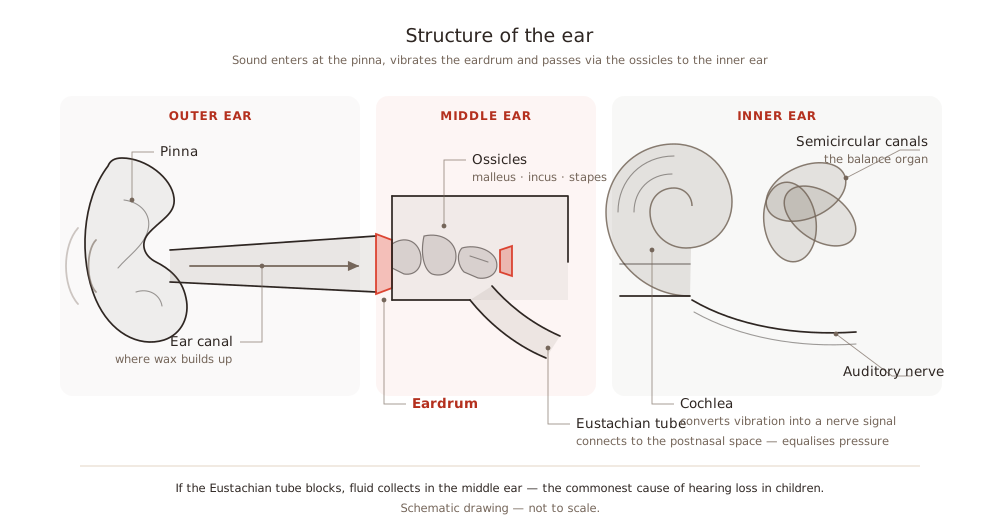
| Conductive | Eardrum and middle ear | Wax impaction, fluid in the middle ear, perforation, otosclerosis |
| Sensorineural | Inner ear or auditory nerve | Age-related loss, noise damage, sudden hearing loss, acoustic neuroma |
| Mixed | Both together |
Most conductive losses can be treated or corrected surgically. This is why the first step for "my hearing has dropped" is a hearing test that establishes which type it is.
The most typical early sign of age-related hearing loss is not sound disappearing but losing the ability to pick speech out of background noise. Not being able to follow a conversation in a busy restaurant is what most people notice first.
Tinnitus
Tinnitus affects 10 to 15% of adults; around 20% of those have it severely enough to need clinical attention.
When it should be assessed without delay:
- One-sided tinnitus
- Bilateral tinnitus lasting longer than six months
- Tinnitus accompanied by difficulty hearing
- Tinnitus pulsing in time with the heartbeat (pulsatile tinnitus)
- Any accompanying neurological sign
Imaging is not needed for every patient with tinnitus; it is needed in the situations above.
When to seek help — the short list
Go the same day:
- Hearing loss developing suddenly in one ear
- Sudden hearing loss with dizziness alongside it
- Sudden fullness and roaring in one ear
Make an appointment without delay:
- One-sided tinnitus
- A clear difference in hearing between the two ears
- Loss that a hearing aid does not resolve
- Delayed speech, or no response to sound, in a child
This content is for general information only; please consult your doctor for diagnosis and treatment.
Sources
- AAO-HNS. Clinical Practice Guideline: Sudden Hearing Loss (Update). 2019. https://doi.org/10.1177/0194599819859885
- AAO-HNS. Updated CPG on Sudden Hearing Loss — fact sheet. https://www.entnet.org/resource/aao-hnsf-updated-cpg-shl-press-release-fact-sheet/
- Hearing Loss in Adults: Differential Diagnosis and Treatment. Am Fam Physician 2019. https://www.aafp.org/pubs/afp/issues/2019/0715/p98.html
- AAO-HNS. Clinical Practice Guideline: Tinnitus. 2014.
Written and medically reviewed by
Ear, Nose and Throat Surgeon · Last reviewed:
Book a consultation
Let us establish the source of your complaint together, through examination and endoscopic assessment.