
Chronic Sinusitis: When Does Surgery Come Up?
The 2025 guidelines dropped the mandatory drug protocol before surgery. What FESS actually does, and what the evidence on balloon sinuplasty says.
Op. Dr. Yaşar Okan Akın · · 8 min read
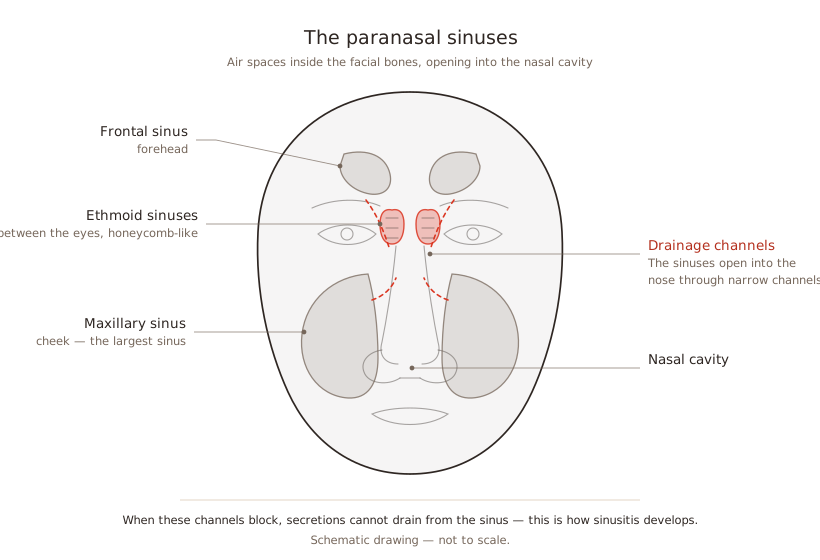
What are the sinuses?
They are air spaces inside the facial bones, opening into the nasal cavity through narrow channels: in the forehead (frontal), between the eyes (ethmoid), in the cheeks (maxillary) and deeper in (sphenoid).
The lining of the sinuses continuously produces secretions, and microscopic hairs sweep those secretions towards the channels. Sinusitis begins when that drainage route becomes blocked.
Diagnosing chronic sinusitis
The criteria are clear. At least two of the following, lasting more than 12 weeks:
- Nasal obstruction or nasal discharge ← one of these two must be present
- Facial pain or a sense of pressure
- Reduction or loss of the sense of smell
Plus an objective finding: polyps, inflammatory discharge or oedema seen on endoscopy, or changes in the sinus mucosa on a CT scan.
There are two subtypes: chronic rhinosinusitis with polyps and without polyps. The treatment approach differs.
Note: for most people who say "I have sinusitis", the symptoms have actually lasted less than 12 weeks and it is acute sinusitis, a different condition that usually resolves on its own.
What changed in 2025?
This section matters, because most sinusitis content online is now out of date. Two separate guidelines were updated in 2025.
Antibiotics in acute sinusitis
| Topic | Old (2015) | New (2025) |
|---|---|---|
| First approach | "Watchful waiting or antibiotics" | "Watchful waiting without antibiotics should be offered" — the recommendation was strengthened |
| Antibiotic duration | 5–10 days | 5–7 days (amoxicillin) |
| Before imaging/surgery | — | Empirical antibiotics are not a mandatory precondition |
What this means in practice: in uncomplicated acute sinusitis the first option is watchful waiting, not antibiotics. Coloured nasal discharge on its own is not a reason for antibiotics.
The end of the "maximal medical therapy" dogma
The most striking clause of the new surgical guideline published in May 2025:
Completion of a predetermined antibiotic / steroid / antihistamine protocol should not be required before surgery.
For years patients were told "use these medicines for this long first; if it doesn't work, then surgery." The new guideline objects to that being imposed as a rigid precondition. The decision is made individually, according to symptom severity, the characteristics of the disease and its effect on quality of life.
Antibacterial treatment is also now recommended only where there is persistent inflammatory discharge documented on examination.
What is endoscopic sinus surgery (FESS)?
It is performed through the nose, with an endoscope, without any external incision.
Its purpose is often misunderstood: it is not about "emptying" or "cleaning out" the sinus. The aim is to widen the natural openings (ostia) of the sinuses and to remove the structures obstructing drainage, so that the sinus's own cleaning mechanism starts working again.
That is why it is called "functional". The sinus mucosa is preserved as far as possible, because the hairs that do the cleaning live in that mucosa.
Balloon sinuplasty — what does the evidence say?
This is one of the subjects most heavily wrapped in marketing language, presented as "a sinusitis solution without surgery".
A correction first: balloon sinuplasty is also a surgical procedure.
A Cochrane review (2022 update) examined the question. The finding is striking: only 1 study met the criteria (34 patients), and the certainty of the evidence was rated very low.
The review's conclusion:
At present there is no convincing evidence to support the superiority of endoscopic balloon dilation over conventional surgical methods in chronic rhinosinusitis resistant to medical treatment.
The 2025 surgical guideline points the same way: where there are polyps, bone erosion, osteitis or fungal disease, the balloon alone is not sufficient — the full sinus cavity needs to be opened and diseased tissue removed.
The honest summary: the balloon may be an option in selected patients with limited disease and no polyps. But there is no evidence for calling it better than conventional surgery.
After surgery: a realistic expectation
Another clause of the 2025 guideline asks that patients be informed before surgery that:
- Chronic rhinosinusitis is a chronic disease
- Recurrence is possible
- Medical treatment (intranasal steroid, saline rinses) may need to continue after surgery as well
Saying this at the outset is better than disappointment afterwards.
Surgery markedly reduces symptoms in most patients. But the expectation of "I had the operation and my sinusitis is completely gone" is not realistic. Surgery restores drainage; it does not remove the underlying tendency to inflammation.
Follow-up: the guideline recommends a symptom assessment and nasal endoscopy 3 to 12 months after surgery.
Common misconceptions
| Misconception | The reality |
|---|---|
| "Every headache is sinusitis" | Most headaches are migraine or tension type |
| "Coloured discharge means antibiotics are essential" | The 2025 guideline ties antibiotics to inflammatory discharge documented on examination |
| "Balloon sinuplasty is the non-surgical solution" | The balloon is a surgical procedure too |
| "If I have surgery my sinusitis will be gone for good" | It is a chronic disease; surgery restores drainage, it does not remove the disease |
| "I have to take medication for months before surgery" | The 2025 guideline removed the mandatory protocol requirement |
Frequently asked questions
Do I need a CT scan? If surgery is planned, yes: a fine-slice CT is needed. But the guideline recommends that the extent of surgery not be based on CT findings alone; it should be judged together with the symptoms.
Does the operation leave an external scar? No. The whole procedure is done through the nostrils with an endoscope.
I have polyps. Will they come back after surgery? The polyp subtype is more prone to recurrence. Regular use of an intranasal steroid afterwards and continued follow-up therefore matter. In resistant cases, biologic therapies may come into consideration.
Do saline rinses help? Yes. They are a standard part of both treatment and post-operative care, and they appear in the guidelines.
I cannot smell. Will it come back? Loss of smell is a frequent feature of chronic sinusitis and is pronounced in the polyp subtype. It can improve partly or completely with treatment, but no guarantee can be given; the timing and the degree vary from person to person.
This content is for general information only; please consult your doctor for diagnosis and treatment. Results of any surgical or interventional procedure vary from person to person.
Sources
- AAO-HNS. Clinical Practice Guideline: Surgical Management of Chronic Rhinosinusitis in Adults. May 2025. https://doi.org/10.1002/ohn.1287
- AAO-HNS. Clinical Practice Guideline Update: Adult Sinusitis. 2025. https://doi.org/10.1002/ohn.1344
- Balloon sinus ostial dilation for chronic rhinosinusitis. Cochrane CD008515. https://www.cochrane.org/evidence/CD008515_balloon-dilation-sinus-openings-chronic-rhinosinusitis
- EPOS 2020 — European Position Paper on Rhinosinusitis and Nasal Polyps. https://pubmed.ncbi.nlm.nih.gov/32077450/
Written and medically reviewed by
Ear, Nose and Throat Surgeon · Last reviewed:
Book a consultation
Let us establish the source of your complaint together, through examination and endoscopic assessment.